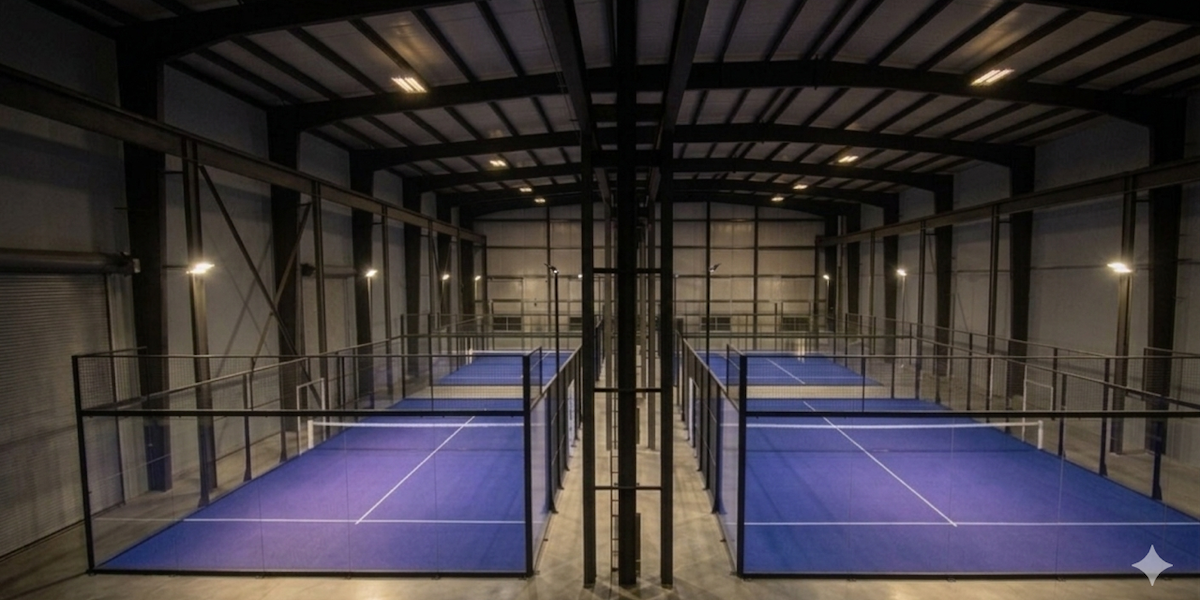
At a quick glance, padel looks a lot like pickleball, but Jake Killion wants to be clear: they are not the same.
You might be forgiven for confusing the two. Padel also features four players with rackets, hitting a tennis-like ball back and forth. Then you look closer, and you realize the court is surrounded by terrarium-like glass walls that the ball can freely bounce against, a combination of tennis and squash. And frankly, the padel players look a lot more winded after a rally.
“Pickleball is what your mom plays,” Killion says. “[Padel] is much more fast-paced. You’re not using a whiffle ball and a cutting board.”
Killion and his wife, Monica Killion, want to introduce the sport to Portland, opening Foundry Padel in Cathedral Park, swinging for a hard opening in early June, with a soft launch for friends and family in March.
The indoor padel club will have four padel courts within an expansive 13,800-square-foot warehouse space on 8613 N Crawford St. A 40-foot ceiling will allow players to go for those sky-high lobs, a “big part of the game,” Killion says. Hoping to keep padel accessible, Killion is aiming to charge $60 per court, per hour, or $15 per player.
Accompanying the play area, Foundry Padel will have a 5,000-square-foot, two-story social area, where guests can get Oregon wine and beer from local breweries and watch other games from the second-story glass railing. Though the social area won’t offer much in the way of food, guests are more than welcome to bring outside food, like the food trucks situated two minutes away from the Foundry Padel.
Killion picked up padel three years ago, finding it a great way to meet strangers. Traveling with his wife in Spain, one of the world’s padel hubs, Killion would meet people through padel. “I’d play for an hour and a half and then have a beer with them afterwards,” he says. Killion wants to bring the community-building capabilities of padel to Portland. “I want it to be a social hive of activity,” he says.
In service of this mission, Foundry Padel will use Playtomic. The matchmaking app groups padel players based on skill level, so lone players can still find a game without having to convince three friends to pick up the game. “You’re meeting people. You’re playing people with a similar skill set,” Killion says. “I can’t wait to introduce new people to this sport.”